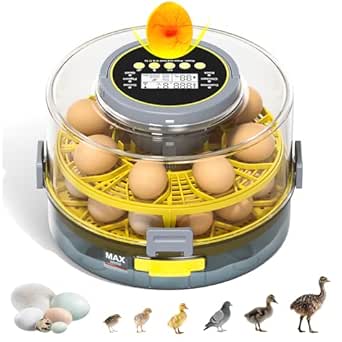
1. Egg Incubator for Hatching Eggs – 20-Egg Capacity with Automatic Egg Turner, Temperature & Humidity Control, LED Egg Candler, 360° Viewing for Chicken, Duck, Quail & Goose Parrot & Pigeon
My grandfather used wooden crates under heat lamps. My grandmother turned the eggs by hand twice a day — morning and evening, no exceptions — and she kept a kitchen timer to remind herself. I watched her do it every spring as a kid and thought it seemed almost impossibly labor-intensive for something that chickens manage without electricity.
When I decided to try hatching duck eggs last spring, I wanted something more controlled than that. I bought a tabletop incubator: 20-egg capacity, automatic turner, temperature and humidity display, LED candler built into the lid. Ran two batches through it over about three months.
Here's what I'd actually want someone to tell me before starting.
---
## What the Machine Is
It's about the size of a large shoebox. Clear plastic sides so you can see inside without opening it. The egg tray sits in the middle and tilts on a motor — it doesn't spin, it rocks, which is how commercial turners work too. The digital panel on the front shows temperature and humidity and lets you set the turning interval. The LED candler is a button on the lid; press it and a light shines through whatever egg you hold up to it.
The capacity is genuinely 20 eggs for chicken-size. Duck eggs fit in the same tray without an adapter. Quail eggs need the smaller ring that comes in the box.
All of this works. The question is how much of the actual work it takes off your plate, and the answer is: some of it.
---
## Temperature
The machine held 99.5°F for my chicken batch. I ran a separate probe thermometer inside to check, and the readings matched within 0.3 degrees across several days. That's more consistent than I expected for something in this price range. I stopped second-guessing it around day four and just let it run.
The digital display doesn't lie. That was my biggest worry, and it turned out fine.
---
## Humidity
This is where I spent most of my mental energy, and I wish someone had been blunt about it upfront: the machine shows you humidity, but it does not control it. There's a water reservoir you fill through a port on the side. To raise humidity, you add water. To drop it, you crack the vent. The machine doesn't pump water in or adjust automatically. You do it, manually, every day.
In my heated apartment in January, the reservoir ran dry in about 36 hours — faster than the instructions implied. I was checking it twice a day for six weeks. Some days I'd come home to a reading eight points below where I wanted it and have no idea how long it had been sitting there.
Chicken eggs want roughly 50-55% humidity through most of incubation, then 65-70% for the final three days before hatch. Duck eggs need more — closer to 55-60% throughout, plus a daily misting of lukewarm water after day 7 to simulate what a wet duck does when she returns to the nest. I didn't know about the misting requirement when I started my duck batch. I figured it out around day 10 from a forum post, which was stressful.
---
## The Automatic Turner
Every 2 to 4 hours, the tray tilts to about 45 degrees in each direction. This is genuinely useful. Turning by hand twice a day sounds manageable until you're also trying to leave for a weekend or just forget. The motor ran without issue through both my batches — quiet, no jams, no missed cycles I could detect.
You do have to stop turning on day 18 (for chickens) or day 25 (for ducks) when lockdown starts — those last few days before hatch when you're not supposed to open the lid at all. The machine doesn't know when day 18 is. You set a reminder yourself and disable the turner manually. I forgot during my first batch and had to reach in at day 18 and switch it off. The chick was fine, but I'd have preferred not to open the lid.
---
## The Candler
You hold an egg up to the LED in the lid and look through the shell. In a dim room, at day 7, you can see whether a spider-web of blood vessels has formed. At day 14, a developing egg is mostly dark with a visible air cell at the wide end. A non-developing egg stays clear, or you might see a faint blood ring, which means early death.
It works fine for white or light-brown chicken eggs. For my Khaki Campbell duck eggs, which have olive-brown shells, the LED wasn't bright enough. I ended up using a purpose-built candling flashlight I ordered separately. The built-in light is a reasonable convenience for standard eggs. For dark shells it's not really adequate.
---
## What Actually Hatched
First batch: 14 chicken eggs, 9 hatched. 64%.
I had a humidity drop around day 12 and opened the lid once at day 16 when I was worried about one egg that looked wrong. Both were mistakes. Whether they're why those five eggs didn't make it — I don't know. It's hard not to wonder. There were five eggs that went nowhere, and at some point you have to candle them, confirm they're not developing, and remove them. That part is a little grim.
Second batch: 12 duck eggs, 7 hatched. 58%.
Duck eggs are harder. Longer incubation (28 days), different humidity requirements, and the misting thing I mentioned. I also think two of my eggs may not have been fertile to begin with — the seller was small-batch and I had no way to confirm. Home incubation in the 50-75% range on a first attempt is apparently normal, which doesn't make it easier when you're counting the ones that didn't make it.
The two ducklings I watched hatch in real-time through the clear panel, without opening the lid — that was worth a lot of the trouble.
---
## The 360° Viewing
The marketing copy makes a bigger deal of this than it deserves. It's clear plastic on multiple sides. Mostly this just means you can watch eggs and chicks from different angles, which is nice during hatch but not particularly useful for the three weeks before that. The real benefit is being able to see activity during hatch without cracking the lid and dropping humidity at the worst possible moment.
---
## Who This Works For
If you're doing chickens or quail for the first time and you want an affordable way to try it without hand-turning, this machine does what it says. The temperature control is reliable. The turner is a genuine time-saver.
If you're doing waterfowl, go in knowing that duck and goose eggs need more active management than the machine provides. The auto-turner and temperature control still help, but humidity monitoring, daily misting, and species-specific incubation periods require research before you start, not during.
The machine handles the parts it's supposed to handle. The attention part is still yours.