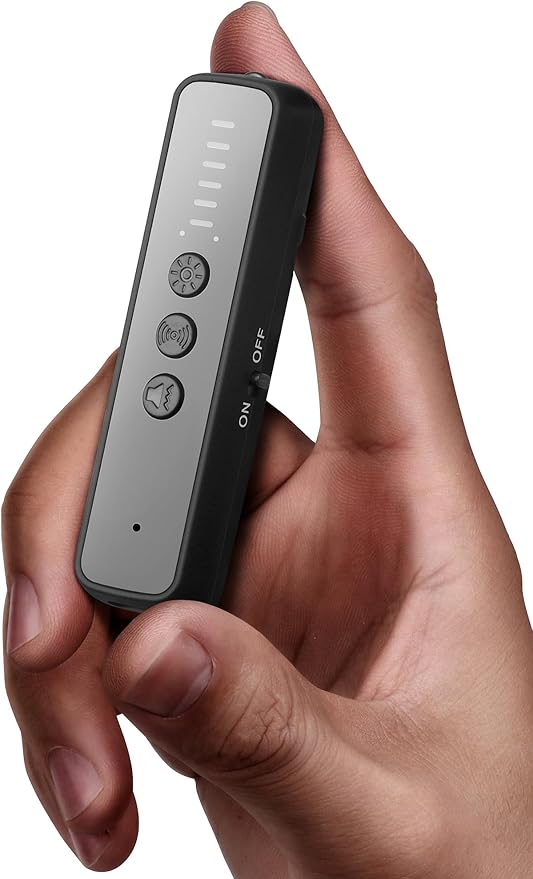
1.Calpol Hidden Camera
2.Mini Wireless Sleep Earbuds for Small Ears
I used to think people who swept hotel rooms for hidden cameras were the tin-foil-hat crowd. Then I spent an afternoon going down a rabbit hole of news stories — spy cams in Airbnb bathrooms, fake smoke detectors in rental bedrooms, cameras disguised as USB chargers in changing rooms — and I stopped feeling so confident about that. I picked up the Calpol AI-Powered Anti-Spy Device before a two-week work trip. Here's what I found.
What you're getting
It's small. Fits in a jacket pocket, which matters. The device combines an RF signal scanner, a GPS tracker detector, and a hidden camera lens finder in one black unit about the size of a chunky TV remote. The LED on the front blinks faster the stronger the signal it picks up. There's also a lens-detection mode — you hold it up to your eye like a stubby telescope and shine it around the room. Camera lenses reflect the light back as a reddish dot.
The box has a charging cable and a paper manual that I'm going to describe charitably as brief.
The first sweep was a mess
I'm not going to pretend I nailed it on day one. RF mode picks up everything — my phone, the hotel Wi-Fi router, the smart TV, whatever the guy in the next room is broadcasting. A modern hotel room is basically a radio soup. The device kept going off and I had no idea what was signal and what was noise for the first ten minutes.
The manual doesn't help much here. It tells you what each mode does but gives you no baseline for what "normal" looks like in a real environment. I found a YouTube walkthrough that explained it better in four minutes than the instructions did on two pages. After that it clicked, and sweeps settled into about five minutes per room once I knew what I was doing.
What it actually detected
In one hotel, the RF scanner lit up near the TV stand. Turned out to be a Bluetooth speaker a previous guest had left plugged in behind the furniture. Not a camera. But I wouldn't have found it without looking, and I wouldn't have looked without the detector going off. That felt like a fair result.
The lens finder I tested at home first against a cheap decoy camera I own. It caught the lens from about six feet. In the hotels, nothing triggered — which I'm going to take as a good sign rather than a calibration problem.
The GPS tracker detection I ran on my car before the trip. No hits there either. Worth being clear: this works on RF-based trackers that broadcast a signal. A purely passive tracker with no wireless component is outside what any consumer device like this will catch. The product doesn't claim otherwise, but it's worth knowing.
Where it actually makes sense to use this
Short-term rentals are the obvious answer. Hotels less so — the risk profile is lower — but I still ran it. Changing rooms, gym locker areas, meeting rooms in shared office buildings. A client of mine asked me to sweep a conference room before a sensitive conversation. That's a real use case and this handled it fine.
Home use is situational. If you're bringing in workers you don't know, or dealing with a living situation where surveillance is a genuine concern rather than a hypothetical one, having a physical tool beats guessing.
What it won't do
This is a consumer device. Professional RF sweep equipment costs a lot more and covers more edge cases. The Calpol catches common commercial spy cameras that broadcast over Wi-Fi or Bluetooth — the kind you can buy on Amazon for twenty dollars and that account for most of what people are actually worried about.
Wired cameras with no wireless transmission? Won't find them. A camera behind a one-way surface where the lens isn't exposed? The lens detector won't help. This is not a knock — it's just what the device is.
Physical inspection still matters. Check alarm clocks, smoke detectors, air vents, and USB chargers, especially ones that were already in the room when you arrived. The detector plus a careful look around beats either one alone.
Two weeks in, I kept it
It's in my travel bag now. The learning curve is short once you get past the first room. The manual could be better. For catching the kind of off-the-shelf hidden cameras that show up in the news, it does the job. If you stay in a lot of rentals and the idea of checking has been nagging at you, this is a practical way to actually do it rather than just worry.
Not a silver bullet. A useful tool. That's what I'd say.