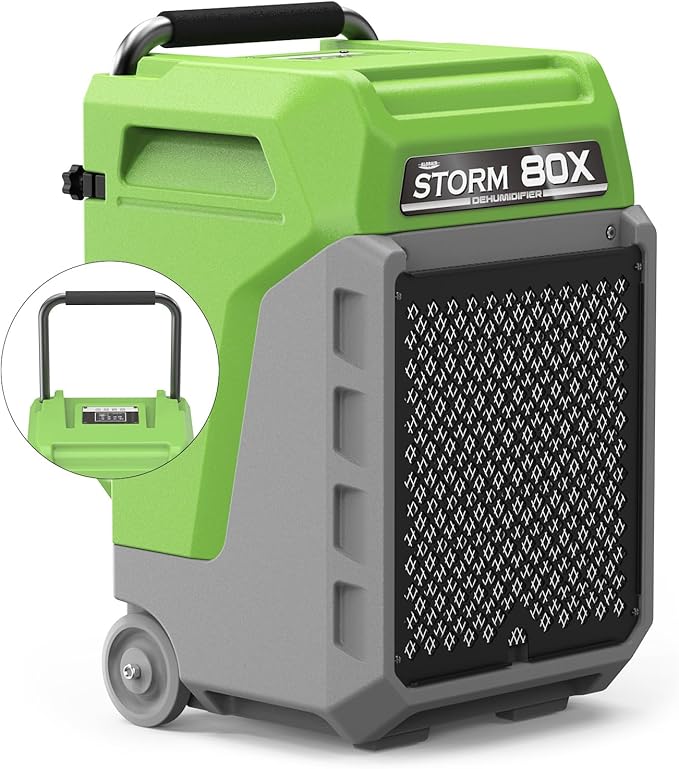
Alorar Storm LGR Commercial Dehumidifier with Pump & Drain Hose, Portable Industrial Dehumidifiers with Wheels for Water Damage Restore, Basement, Garage, 5 Years Warranty
My brother-in-law called me in a panic last October. His basement had about two inches of standing water after a pipe burst overnight, and the restoration company quoted him $4,200 just to dry it out. I told him to hold off.
That's how I ended up spending a week babysitting a dehumidifier.
The machine we rented — and later I bought one for myself — was the AlorAir Storm LGR Commercial Dehumidifier. I'd seen it come up repeatedly in water damage forums. At around $800–$900 depending on where you find it, it's not cheap, but comparing that to what the pros were quoting us, trying it first felt obvious.
---
## What "LGR" Actually Means
LGR stands for Low Grain Refrigerant. It describes a refrigeration cycle that pre-cools the incoming air before it hits the main evaporator coil. Standard dehumidifiers lose effectiveness when ambient humidity drops below roughly 40–50%. An LGR unit keeps pulling moisture in those lower conditions, which is exactly when you need it most in a drying job.
Most residential units slow down well before a basement is genuinely dry. The AlorAir kept working long after a cheaper unit would've coasted.
---
## Setup
The unit comes with wheels. That sounds minor until you're trying to maneuver 80 lbs across wet concrete at 11pm. The drain hose connects at the back with a standard garden hose fitting, and the built-in pump can push water up roughly 16 feet vertically, so you're not tied to a floor drain.
We ran the line into a utility sink. Ten minutes start to finish.
The control panel is basic, which I mean as a compliment. Set your target humidity, set your fan speed, done. There's a continuous drain mode that bypasses the internal bucket entirely. For any real drying job, that's the mode you want.
---
## What It Actually Did Over Seven Days
I checked the basement twice a day. The unit pulled roughly 10–15 liters out of the air every day for the first three days. By day five we were down to maybe 3–4 liters. By day seven, humidity was sitting at 45%, down from around 85% when we started.
The wall and floor moisture readings tracked the same direction. We were checking framing and drywall with a pin-type moisture meter each morning.
Would a restoration crew have moved faster? Probably — they'd bring multiple units, air movers, possibly a desiccant system for the stubborn spots. But for what we paid on one rental unit versus the $4,200 quote, the tradeoff was easy to accept.
---
## The Parts That Annoyed Me
It's loud. At full fan speed, somewhere around 65 dB, not so loud you can't be in the same house, but enough that we kept the basement door closed and stopped going down there unless we had to. If you're running this in a living space, lower fan settings exist.
The filter collects a lot of debris, especially in a water-damaged environment. I cleaned it twice during the week. Not a dealbreaker, just something to stay on top of.
The power draw is real. This pulls about 7.7 amps continuously off a standard 120V outlet. Make sure the circuit isn't already carrying much else.
---
## Whether It Makes Sense to Buy vs. Rent
If you're a property manager, a DIY landlord, or someone who's dealt with water damage more than once, buying makes sense. Rental fees compound quickly, and having a unit ready when something goes wrong has obvious value.
If you're a homeowner who had one incident and probably won't face another for years, renting is the smarter move. The AlorAir does its job well, but you'd be paying for commercial capacity you don't need to own.
For this particular job, we came out somewhere between $3,000 and $3,500 ahead of what the restoration quote would've cost. Hard numbers are easier to argue with than feelings about it.
---
## On the Warranty
AlorAir backs this unit with a 5-year warranty, which is longer than most dehumidifiers I've looked at. I haven't needed to use it, so I can't tell you how the claims process actually goes. For a machine at this price, I'd want to know before buying rather than finding out during a problem.
---
## Short Version
The AlorAir Storm LGR does what it says. The LGR cycle matters in practice, not just on the spec sheet. The pump and drain hose setup is genuinely useful for real jobs rather than a checkbox feature. And yeah, the wheels get used.
It's noisy, it's heavy, and the price makes you pause. Whether that's worth it depends entirely on how often water damage is a part of your life.
For us, it was.