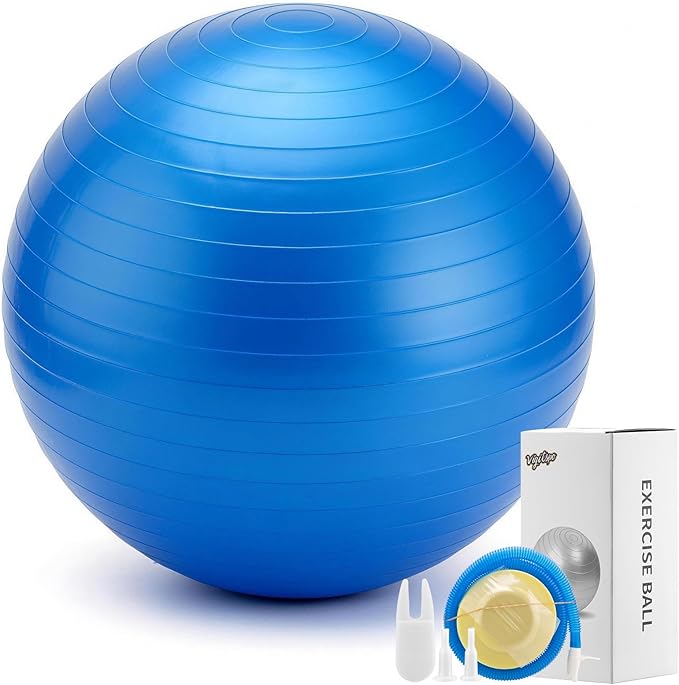
Exercise Ball – Puncture-Resistant Yoga Ball for Core Strength, for Core Strength Recovery, Balance & Stability Workouts, Multiple Sizes & Colors
I didn't do this for content. I did it because my lower back was getting worse and my physiotherapist told me to work on my core. The exercise ball was already sitting in the corner of my home office, half-deflated, bought two years ago with good intentions and abandoned by February.
So I pumped it up, swapped it for my chair, and used it as my main seat for a month. Then I started using it for actual workouts. This is what I learned.
---
## The ball itself
The one I ended up using is marketed as a puncture-resistant yoga ball — multiple sizes and colors, built for core workouts and balance training. I went with the 65 cm version, which is the standard pick for most people between 5'5" and 5'11". It holds air well. The surface has enough texture to grip the floor without sliding around every time you shift weight.
The puncture-resistant claim is mostly accurate, with a caveat. It's slow-deflate rather than burst-proof. If something does puncture it, you don't get a sudden collapse — you notice the air leaving before you end up on the floor. That distinction matters more than people think, especially if you're using it for elevated exercises.
---
## Sitting on it all day
Eight hours on an exercise ball as a chair replacement is not comfortable. It's not supposed to be. You're constantly making small adjustments to stay balanced, and your core does work. But by hour four or five, your lower back gets tired rather than strengthened. I started slouching on the ball the same way I slouch in a bad chair. Just rounder.
What worked better was alternating — 90 minutes on the ball, then switching back to a regular chair. That kept the engagement without turning into a fatigue experiment.
Worth saying: if your physiotherapist has suggested stability ball sitting as part of rehab, that's a different context. There's a gap between "my physio recommended this with specific guidance" and "I saw it on YouTube and decided to ditch my chair." The second one doesn't go as well.
---
## The workouts
This is where the ball earns its place.
Crunches on the floor and crunches with your lower back on the ball, hips extended, feet flat — those are genuinely different exercises. The instability pulls in muscles that stay quiet during floor work. I noticed this quickly.
Planks with feet elevated on the ball are harder than standard planks, not dramatically so, but enough that I felt it by the third set. Wall squats with the ball between your back and the wall were something I leaned on when my knee was irritated and I didn't want to free-squat. Controlled range of motion, easy to stop before it hurts.
Hip bridges with feet on the ball taught me fast how inconsistent my engagement was. The ball rolls slightly when you're not stable. It's an immediate, physical piece of feedback — more useful than trying to monitor yourself in a mirror.
The exercise I used it for most was dead bugs. Lying on your back, ball held between knees and elbows, extending opposite limbs. A physiotherapist friend introduced me to this for lower back work. It's slow, controlled, and doesn't look impressive, which is part of why it's actually good.
---
## On the recovery stuff
I want to be careful here because "recovery" gets stretched pretty thin in fitness marketing. The ball is not going to fix an injury. What it can do is give you an adaptable tool for rebuilding stability — particularly in the core and hips — after something has gone wrong.
Adaptable is the word I'd hold onto. You can make most exercises easier or harder by adjusting how much of the ball you're on, how much load you apply, how fast you move. For someone coming back from a disc issue, that flexibility is useful. But you want a physio in the loop, not just a product description.
---
## Getting the size right
Most brands sell 45 cm, 55 cm, 65 cm, and 75 cm. The rough breakdown:
- Under 5'4" — 55 cm
- 5'4" to 5'11" — 65 cm
- Over 5'11" — 75 cm
The test is simple. Seated on the ball with feet flat, your knees should land at roughly 90 degrees, hips level or slightly higher. If your knees are above your hips, go up a size. If they're below, come down.
I'm 5'9" and the 65 cm is right. I tried a 75 cm briefly and felt too high up for any controlled seated exercise — like doing ab work from a bar stool.
---
## Colors
I got grey because it was available and I didn't think hard about it. These come in blue, purple, pink, black, green, and probably a few others depending on where you buy. It has no effect on anything functional. I will say the purple and blue ones photograph better for Instagram, if that matters to you. I'm not judging. Just being accurate.
---
## What it won't do
It won't replace a gym if you're after significant strength. The same instability that makes it good for core activation also limits how much load you can move safely. You're not building a back squat with a stability ball.
And it won't do the work for you. Every fitness product review that ends with "if you put in the effort, this will change everything" is covering for a weak argument. The ball is a prop. A decent one. But it extends your effort — it doesn't substitute for it.
---
## Practically speaking
If you're rebuilding core stability after injury or a long stretch of not moving much, a good stability ball in the right size is a useful thing to have. Same if you work from home and want something to break up sitting without a commute to the gym. Same if your physio has specifically told you to use one.
If your core is already in good shape and you're moving regularly, it'll probably live in a corner. I say that not as criticism but as a fair read of who actually benefits. Mine sat unused for two years before I had a real reason to pick it up again. Now I use it three or four times a week.
That's probably the most honest thing I can say about it.